

Summary
- The Spidercam moves above the pitch using multiple cables.
- Motorized winches and specialist operators control its position.
- A gyroscopically stabilized head keeps the footage smooth.
- The system provides aerial angles that fixed cameras cannot capture.
- Contact between the ball and a cable is considered outside interference.
- The England–Norway controversy highlighted the technology’s operational challenges.
- What Is the Spidercam?
- How It Moves Above the Pitch
- Two Operators for One Shot
- How the Footage Remains Stable
- What Kind of Footage It Provides at the World Cup
- Why Cables Are Used Instead of a Drone
- How Low Can It Go?
- Can the Ball Hit a Cable?
- What Happens if Contact Occurs?
- What Happens in the Event of a Technical Failure?
- What We Think
- Frequently Asked Questions
The Spidercam moves above the pitch using cables, providing dramatic footage while also raising questions whenever it comes close to the path of the ball.
The aerial camera system is an important part of television coverage inside the 2026 World Cup stadiums, as it can follow the players and the action from positions that fixed cameras cannot reach.
Its operation came under scrutiny following the controversy during the England–Norway match, when the Norwegian side claimed that the ball may have touched an aerial camera cable before Jude Bellingham’s goal. FIFA said that the sensor inside the ball did not record contact, but the incident brought renewed attention to the way these systems work and the safety limits governing their use.
What Is the Spidercam?
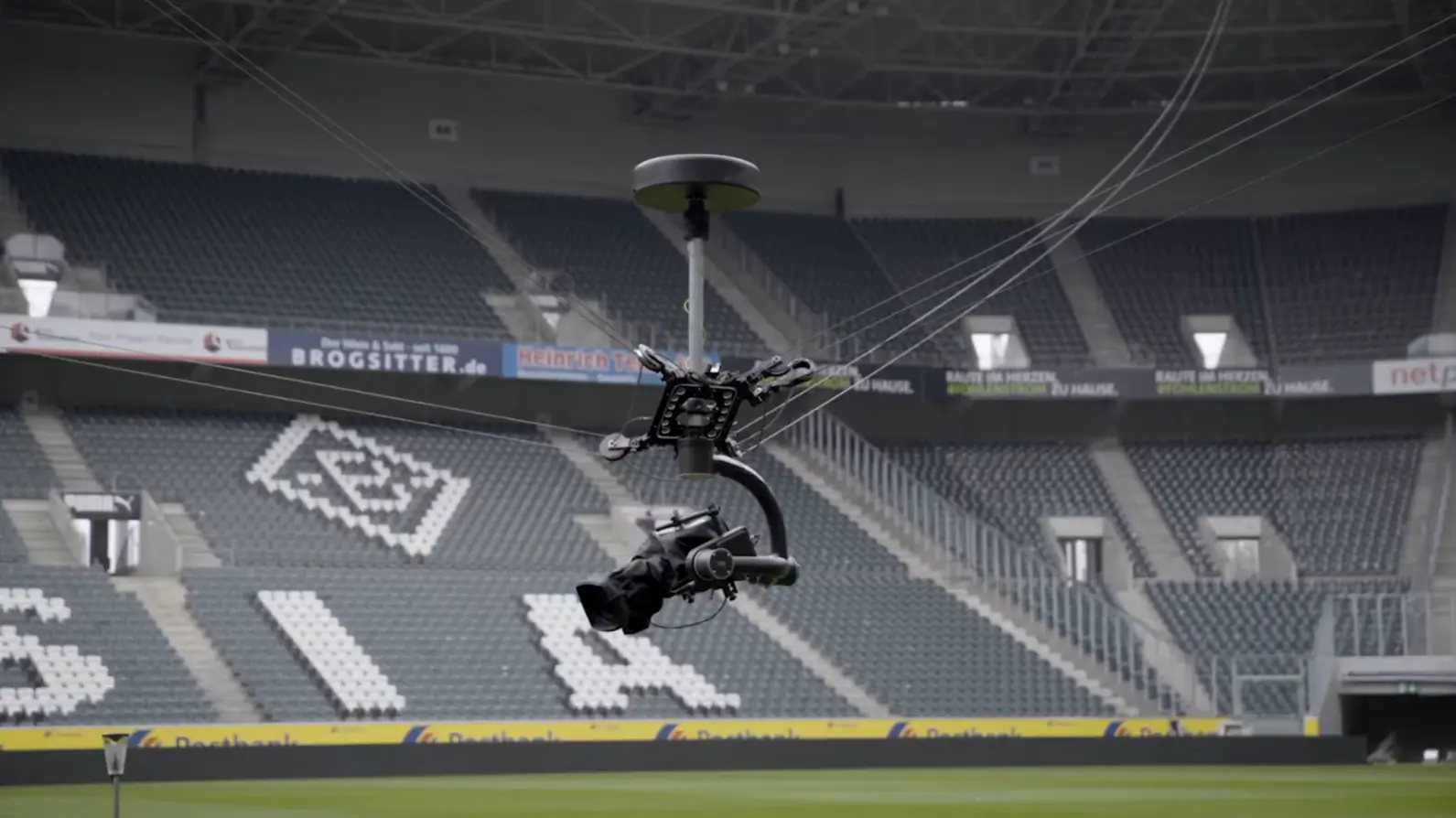
The Spidercam is a filming system in which a television camera is suspended above a large, predetermined area with the help of multiple cables.
Inside a football stadium, the cables extend from different points around the playing area and connect to the platform carrying the camera.
The system takes its name from the arrangement of the cables, which resembles a spider’s web. Despite the impression created by the television footage, the camera does not fly freely and does not operate like a drone.
How It Moves Above the Pitch
Movement is achieved through motorized winches that wind or release the cables in a precisely coordinated way.
When one cable becomes shorter and another is released, the platform moves in a specific direction. By controlling all the cables simultaneously, the Spidercam can travel forwards, backwards, sideways, upwards or downwards.
Its position is continuously calculated by the control system, allowing movements to remain smooth and within the predetermined operational limits.
Two Operators for One Shot
Operating a Spidercam usually requires separate specialists to control the movement of the platform and the television camera.
The first operator determines the system’s direction, speed and height. The second controls the framing, camera rotation, focus and zoom.
Both operators work with the television director, who decides when the Spidercam footage will be included in the live broadcast.
How the Footage Remains Stable
The camera is mounted on a gyroscopically stabilized head that reduces vibrations caused by movement, wind and changes in cable tension.
Without this technology, the images would display severe shaking and sudden shifts in the horizon.
Stabilization allows the Spidercam to follow a fast counterattack or descend towards the playing area while keeping the footage smooth enough for live television.
What Kind of Footage It Provides at the World Cup
The Spidercam can travel behind an attacking move, pass over the centre of the pitch or provide a wide view of the formations of both teams.
It is frequently used during the players’ entrance, before kick-off, after a goal and during breaks in play.
Its ability to change altitude creates footage that combines the perspective of an aerial shot with the proximity of a camera positioned almost inside the action.
It does not replace traditional fixed cameras but complements the broadcast system with more dynamic and cinematic viewing angles.
Why Cables Are Used Instead of a Drone
A drone could theoretically follow a similar route, but flying directly above footballers and tens of thousands of spectators would create more serious safety concerns.
The Spidercam remains attached to a controlled system and travels only within a predefined area. It also does not rely on a small battery to stay in the air.
It can carry a larger camera, lens, stabilization system and transmission equipment than a conventional drone.
How Low Can It Go?
The minimum permitted height depends on the tournament, the stadium configuration, the stage of the match and the protocols followed by the broadcast team.
Operators cannot move the camera freely to any position they choose. The system includes defined limits restricting the areas and heights it can reach.
During active play, greater distance is required from the players and the possible path of the ball. Lower movements may be used before the match, after the final whistle or during controlled shots when play is not taking place.
Can the Ball Hit a Cable?
The cables are positioned to remain at a safe height, but a football can travel very high following a goalkeeper’s kick, a clearance or a long pass.
The England–Norway incident demonstrated how difficult it can be to establish whether contact occurred, particularly when the ball and the cable appear in the same part of the image for only a fraction of a second.
A change in the ball’s flight is not, by itself, proof of contact. Clear television footage, data from the connected ball or other technical evidence may be required to determine what happened.
What Happens if Contact Occurs?
A cable or camera positioned above the pitch is considered an outside agent.
When the referee establishes that the ball has touched the system, play must be stopped. The match is then restarted with a dropped ball at the location of the outside interference, according to the relevant procedures.
This means that an attacking move beginning after such contact should not be allowed to continue normally. The main difficulty is confirming the incident quickly and beyond reasonable doubt.
What Happens in the Event of a Technical Failure?
The system includes safety procedures for dealing with a malfunction, loss of communication or a problem affecting one of the winches.
A technical team monitors its operation, while the cables, connections, motors and camera platform are inspected before use.
When a problem is detected, the Spidercam can be moved to a safe position and removed from operation until the necessary technical inspection has been completed.
What We Think
The Spidercam has changed the visual language of televised football by delivering dramatic images that bring viewers closer to the action. The England–Norway controversy shows, however, that an impressive shot cannot take priority over the safety and integrity of the match. Operational limits must remain clear, while any possible contact with the ball should be examined through a transparent and technically documented process.
Frequently Asked Questions
Is the Spidercam a drone?
No. The Spidercam is suspended and moved by cables connected to motorized winches positioned around the playing area.
Who Controls the Spidercam?
The system is operated by specially trained professionals. One person usually controls the movement of the platform, while another manages the camera and framing.
Why Does the Image Remain Stable?
The camera is mounted on a gyroscopically stabilized head that reduces vibrations and keeps the horizon smooth during movement.
What Happens if the Ball Hits a Cable?
The referee must stop play when contact is confirmed, as the cable is considered an outside agent. The match is restarted with a dropped ball.
Why Is a Drone Not Used Instead?
The Spidercam moves within a controlled and predefined area, can carry heavier television equipment and does not depend on a battery to remain in the air.